9. After you submit¶
Produces: a finalized, published result, as long as you keep responding to reviewers.
Before you begin
- Completed 8. Submit
- Status is
REVIEW_PENDING - Someone is on the hook to respond within 3 business days for the next six weeks
Don't treat this as an afterthought. It's easier to lose a submission here by not replying to reviewers than by failing a technical check at Week 0.
What happens, and when¶
| Phase | Window | Your obligation |
|---|---|---|
| Automated compliance | Week 0 | Nothing — but a failure rejects the submission outright |
| Peer review | Weeks 1–3 | Respond to every objection within 3 business days |
| Objection resolution | Weeks 4–6 | Provide a fix or formal resolution within 3 business days |
| Dispute resolution | From Week 6, ~5 weeks | File a written statement within 10 business days of notification |
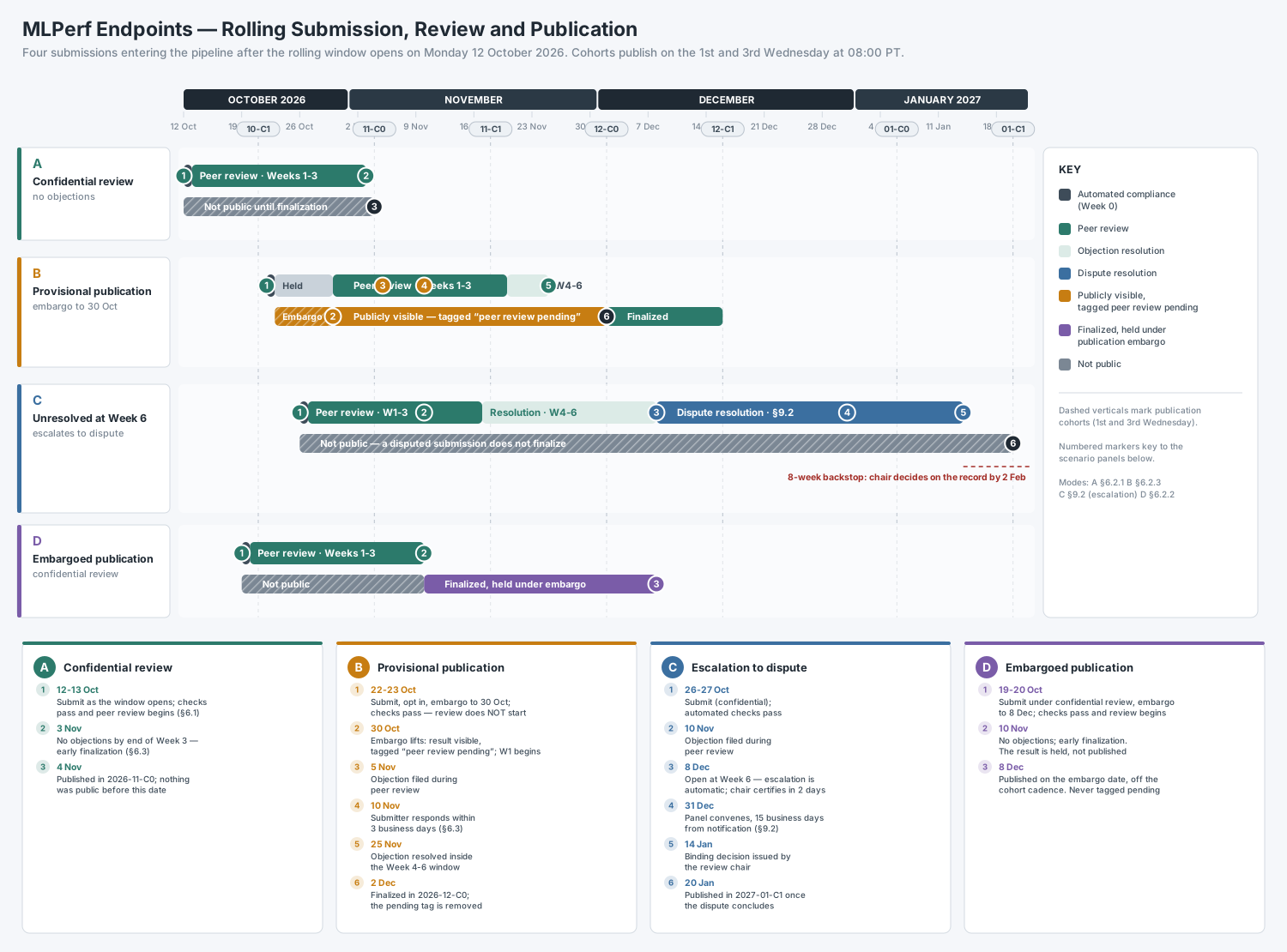
Four example submissions, one per publication mode, from §4.5 of the Submission Rules. Select the image to open it full size.
Timelines anchor to the cohort your submission first appears in, not the day you uploaded. The full schedule is in §6.5 of the Submission Rules, and the dispute deadlines in §9.2.
The response clock¶
Silence withdraws your submission
Penalties start automatically once an objection is filed and don't reverse if you reply late: finalization slips one cohort after 3 business days without a response, two after 6, and the submission is withdrawn after 10. The schedule, and how business days are counted, is in Submission Rules §6.3.
A reply only counts if it either acknowledges the issue with a schedule for resolution or contests it with evidence (§6.3). A holding reply with no schedule and no argument is not a response. What the objector owes you in return is in §6.4.
What reviewers are looking at¶
The minimum scope of a review is in Submission Rules §2.6. Human reviewers concentrate on what automation can't check, listed in §9.2 of the rules: curve shape, suspicious metric distributions, TTFT and token-count gaming, warmup data, Offline pass boundaries, and whether your system description matches what ran.
Objection types and what they cost you¶
Every objection has a type, and the type sets its severity (Submission Rules §6.8). Division and availability objections usually end in reclassification rather than withdrawal, and cosmetic ones don't block finalization.
A reproducibility objection has to show a deviation beyond the throughput margins in Reproducibility Expectations: 10% for an independent re-run, 5% on the exact same system.
Latency cannot carry an objection on its own
The margins don't apply to ttft_p90_ms or any other latency percentile, and until the working
group ratifies a method, a reproducibility objection can't rest on latency alone (same section).
Accuracy always has to pass. No margin, at any stage.
What you may and may not change¶
During peer review you can update run and submission metadata only when the review committee asks (Updating submissions during peer review). Non-result content such as documentation, system description metadata and configs that don't match the run can be corrected; results can't (Submission Rules §8.1).
Results may not be changed during review
If a measurement point is wrong, your options are to withdraw that point (submissions
remove-run) or withdraw the whole submission. Withdrawn points do not count toward the minimum
point count. §8.1 says that may mean submitting additional points, but there's no way to add a
point to a submission (step 8), so in practice the
shortfall can't be repaired.
After finalization, a wrong result means invalidating the affected points or the submission, and non-result corrections need review-chair approval (same section).
Finalization and publication¶
Once every objection is resolved or retracted, the result is finalized, early if that happens before the end of Week 3 (§6.3). It's queued for the next available cohort (§6.3), or held until your embargo date if you declared one (§4.2).
What the published entry shows is listed in Submission Rules §7.6, and how the Offline point is plotted in §5.7.3 of the rules. If MLCommons had to fill in any of your power figures, the result is tagged "MLC Estimated Power".
Your obligations after publication¶
- Retain the system for a possible audit until the result settles: the later of the next audit vote or 90 days after finalization (Scope and Standing for Late Concerns).
- Keep it as submitted if you're nominated for audit. Nominations are open for 4 weeks after publication, and from nomination the system has to stay in its submitted configuration, even past the 90 days (§10.2). See Audits.
- Keep a Standardized CoN endpoint reachable for at least 90 days after publication, with a point of contact (§7.2.5).
- Honour a Preview commitment: Available and re-submitted within 180 days of first publication, with one possible extension (§7.3). See Publication status.
- Use the right name. Unqualified "MLPerf Endpoints" means Standardized; Serviced, RDI and Preview results carry qualified names (§2.2.3, §2.3.2, §2.4.2, §7.3.8).
Verify¶
endpoints-submission-cli submissions get --submission-id <submission-id>
You are done when status reads FINALIZED, and published when it reads PUBLISHED. Full state
list: Submission states.
Next¶
Nothing. You've finished the workflow. If something went wrong, see Troubleshooting or Getting support.